
Over the years, many students from BCTS have left a profound and lasting impact on Baldwin County, influencing many facets of its educational system, political landscape, and broader community development. As the school became a vital institution during segregation, its alumni played key roles in advancing educational opportunities, shaping local politics, and advocating for social justice. Many graduates emerged as leaders, educators, and advocates, driving meaningful changes that addressed systemic inequalities. Their efforts helped transform Baldwin County’s schools, politics, and community life, leaving an enduring legacy of progress and empowerment for future generations. One such individual is Ms. Agee, whose connection to BCTS shaped her path and inspired her to pursue a career in education.
Gartrell Agee
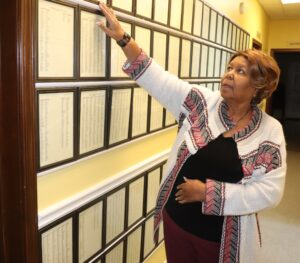
Ms. Agee’s connection to BCTS was a defining influence on her career path. Her experiences at BCTS inspired her to further her education and pursue a teaching degree at Alabama State University. This journey, shaped by her time at BCTS, fueled her passion for education and motivated her to return to Baldwin County, where she dedicated herself to improving the educational system. Her story highlights how BCTS played a pivotal role in guiding her toward a meaningful career in education, ensuring the values and opportunities she received would continue to benefit future generations.
Ms. Agee describes her time at BCTS as a pivotal period that ignited her passion for education and set her on her future path. Inspired by the leadership of the Carrolls and their steadfast commitment to providing quality education despite overwhelming challenges, Ms. Agee recalls her school years with a mix of fondness and realism. While she greatly benefited from the warmth and encouragement of her teachers, she was fully aware of the pervasive racism and fear that shaped her daily experiences. She and her classmates often walked long distances in the sweltering heat to reach school, a harsh reality of the systemic inequalities embedded in the Jim Crow South. These shared struggles created a powerful bond between students and teachers, uniting them against the injustices they faced.
While attending Alabama State University during the volatile period of integration, Ms. Agee Gartrell witnessed firsthand the fear and uncertainty that gripped the lives of African American students. One particular incident stands out in her memory: trucks filled with white men would arrive on campus at night, posing a threat to the safety of the students. In response, male students would leave their dorms to stand guard around the female dormitories, ensuring their protection from potential violence. This experience, a stark reminder of the dangers surrounding desegregation, left a lasting impact on Ms. Gartrell and fueled her determination to fight for educational equity. She recalls, “At night, trucks of white men would come onto the campus. When they arrived, someone would alert everyone, and the boys’ dorms would empty as the men came out to protect the girls’ dorms at Alabama State.”
Ms. Agee’s experiences during integration were deeply formative, shaping her understanding of the systemic racism that pervaded American society. The threats and intimidation she endured, while terrifying, fueled her determination to resist these injustices. Over time, Ms. Agee came to believe that education was a powerful tool for empowering children to overcome the racial barriers embedded in the system. She saw teaching as a way to equip future generations with the knowledge and resilience necessary to challenge inequality. Inspired by local grassroots efforts, such as those led by the ESMBA, Ms. Agee’s experiences underscored the importance of activism and education in bringing about meaningful change.