
Principal Wilson
As the first official principal of Baldwin County Training School (BCTS), Ligon A. Wilson played a pivotal role in shaping the institution and fostering strong relationships with the surrounding community. Wilson worked diligently to build trust with the Baldwin County Board of Education, local trustees, teachers, and the citizens of Daphne. His ability to collaborate effectively with these groups not only solidified the school’s standing within the community but also made Wilson a respected and influential figure in Baldwin County. Through his leadership and outreach, Wilson became the face of BCTS, embodying its mission and vision. His commitment to the school and its students cemented his status as a vital member of both the BCTS family and the broader Baldwin County community, ensuring the institution’s success and growth during his tenure.[1] Thanks to Wilson’s dedicated efforts, the number of boarding students grew significantly, increasing from ten to forty by 1919. This remarkable progress demonstrated the school’s growing reputation and its vital role in providing education for African American students in Baldwin County and beyond. Wilson’s success in expanding enrollment also caught the attention of the Baldwin County Board of Education, which, recognizing the school’s importance, agreed to pay tuition for these boarding students during the 1919 and 1920 school semesters. This support marked a significant milestone for BCTS, further solidifying its place as a cornerstone of educational opportunity for the African American community.[2]
A Changing Focus
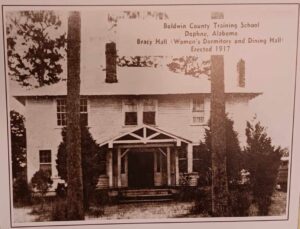
Thanks to the efforts of Principal Wilson. Over the years, BCTS steadily grew into a vital asset for the African American community in Baldwin County, earning widespread support for its transformative impact. As the school gained recognition, the community expanded its vision for BCTS, shifting its focus from solely vocational education to a broader cornerstone of learning. This evolution aimed to provide students with the tools to achieve economic self-sufficiency and transcend the societal limitations imposed by Jim Crow. Through collective support from organizations like the ESMBA and local leaders, BCTS became a beacon of hope and progress, empowering its students to overcome systemic barriers and aspire to unattainable opportunities.[3]
Under the leadership of Principal Wilson, BCTS underwent a remarkable transformation, evolving from a modest one-room schoolhouse into a comprehensive educational facility. By 1923, Wilson had overseen an extensive building program that expanded the campus into a five-building complex, which included a two-story academic building, an administrative building, dormitories for boys and girls, a domestic sciences building, and a boys’ industrial training building. These developments allowed BCTS to provide residential accommodations and a diverse curriculum emphasizing vocational and academic training. This transformation significantly enhanced the school’s ability to serve the community, establishing it as a cornerstone of African American education and a vital institution for regional development.[4].During its early years, BCTS operated as a boarding school until the 1940s, serving as a central hub for African American education in Baldwin County. By the 1920s, the school employed seven teachers and a principal, enrolling nearly 200 students, many of whom traveled long distances to attend.[5]
The Birth of BCTS
In 1927, Ligon A. Wilson solidified the school’s new public identity through a landmark event known as the Baldwin County Heritage Festival. During this celebration, Wilson, in collaboration with the Eastern Shore Missionary Baptist Association (ESMBA), officially renamed the school from the Eastern Shore Industrial Colored School to Baldwin County Training School. This renaming represented the institution’s transformation from a modest one-room schoolhouse into a vital center for advanced education and vocational training for African American students across the region. It marked a pivotal moment in the school’s history, reflecting its expanded mission to empower the African American community through education. Wilson’s visionary leadership redefined the school’s identity and established it as a cornerstone of progress and opportunity.[6]
Wilson’s tenure as principal marked a period of remarkable transformation for BCTS, driven by his relentless focus on improvement and public advocacy. This transformation was symbolized by a visit from the renowned lawyer and social reformer Clarence Darrow, whose presence highlighted the school’s significant progress under Wilson’s leadership. Darrow praised the advancements made at BCTS, drawing attention to the collaborative efforts of its staff, students, and community. His recognition brought national attention to the school, showcasing it as a model of educational opportunity and resilience. This moment underscored Wilson’s unwavering dedication to providing meaningful educational opportunities for African Americans in Baldwin County and solidified BCTS’s status as a beacon of progress and hope during a challenging era.[7]
Until his retirement in 1927, Ligon A. Wilson worked diligently to enhance Baldwin County Training School, elevating it into a respected institution for African American education in Baldwin County and beyond. Under his leadership, the teaching staff expanded to seven, significantly improving the quality of instruction and the school’s ability to serve its growing student body. Wilson also oversaw major improvements to the dormitory building, which allowed the school to accommodate nearly ten boarding students from neighboring counties. These students, who paid nine dollars per month, were provided with individual rooms, a rarity at the time. The school operated as a boarding institution until the 1940s, educating nearly 300 students annually during his tenure. [8]
Footnotes
- http://Daphne Black Education Museum Text “The History of BCTS Poster.” Museum Exhibit 1970 Par-1
- http://Daphne Black Education Museum Text “The History of BCTS Poster.” Museum Exhibit 1970 Par-2
- http://Daphne Black Education Museum Text “The History of BCTS Poster.” Museum Exhibit 1970 Par-3
- http://Baldwin County Training School.” YouTube. https://youtube.com/watch?v=uRyVmnw4wiw. October 15, 2013, 9:00
- http://Baldwin County Training School.” YouTube. https://youtube.com/watch?v=uRyVmnw4wiw. October 15, 2013, 9:15
- May 10, 1918, Page 1.” – Fairhope Courier at Newspapers. Com. Fairhope Courier. May 10, 1918 Pg.1 Par-1
- May 10, 1918, Page 1.” – Fairhope Courier at Newspapers. Com. Fairhope Courier. May 10, 1918 Pg.1 Par-2
- Danly Nancy “The History of Baldwin County Training School” 2009 pg.9 par-1