The Beginning
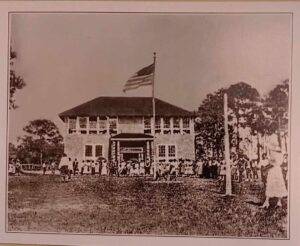
Nestled near the shores of Mobile Bay in Daphne, Alabama, Baldwin County Training School (BCTS), originally named the Eastern Shore Industrial Colored School, was established in the aftermath of the Civil War as one of the area’s first segregated schools. Initially a small private institution, the school catered primarily to the African American community, eventually becoming the first secondary school in Baldwin County to teach grades 8-12.[1] It served as the pinnacle of the public feeder school system for African American students across the county, providing opportunities for education and empowerment despite the systemic barriers of segregation. Today, this historic site houses the Daphne Black Education Museum, a testament to the resilience and determination of the African American community during and after the Reconstruction Era. The museum preserves the legacy of the educational struggles and triumphs of Baldwin County’s African Americans, standing as a powerful reminder of the community’s rich heritage and enduring commitment to progress.[2]
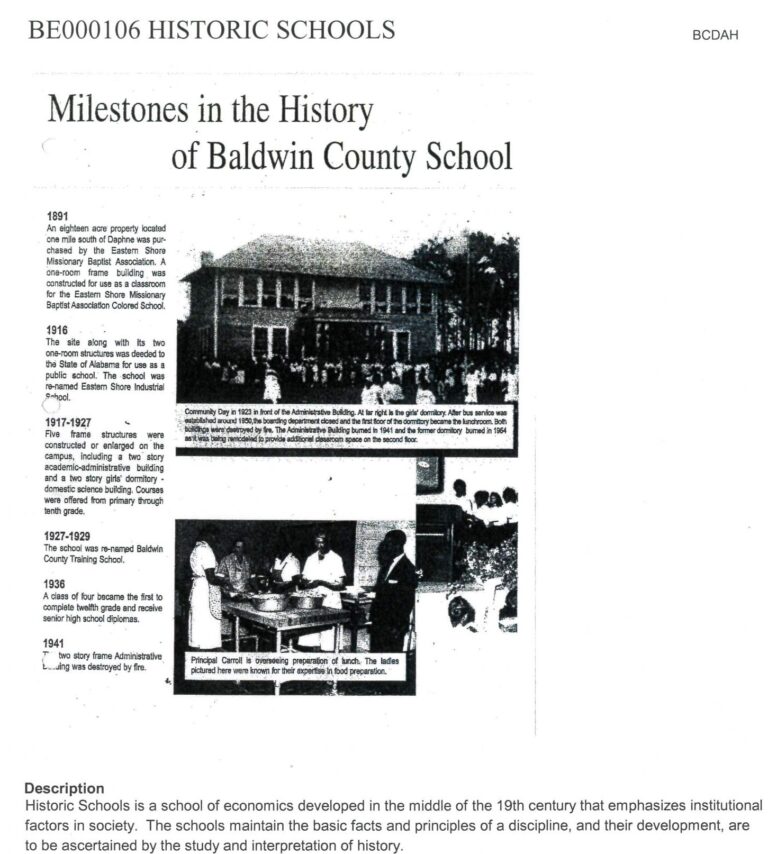
The origins of what would later become Baldwin County Training School can be traced back to 1889, under the visionary leadership of Reverend S.B. Bracy, pastor of Macedonia Missionary Baptist Church and newly elected moderator of the Eastern Shore Missionary Baptist Association. Recognizing the urgent need for educational opportunities for African American children in Baldwin County, Rev. Bracy and the association purchased an 18-acre plot of land in Daphne, Alabama. There, they built a modest one-room schoolhouse, which began as a private institution focused on teaching and training African American students. From 1889 to 1916, it was known as the Eastern Shore Missionary Baptist Association Colored School. This effort represented a significant milestone in empowering the local African American community through education and laid the groundwork for what would become a cornerstone of the region’s educational and cultural development.[3]
In its early years, the school operated without a dedicated principal, with most administrative and instructional duties carried out by Reverend S.B. Bracy and other members of the ESMBA. The institution functioned as a Sabbath school on the 18 acres of land purchased by the ESMBA. It served as a one-room private school primarily for the members of Macedonia Baptist Church. There, Bracy taught congregation members to read and write, focusing on training future deacons for the church. By 1911, Bracy and the ESMBA expanded the school by constructing a second one-room building, which was used as an additional classroom to accommodate the community’s growing needs.[4]
A Growing Asset
Over the years, thanks to the unwavering dedication of Reverend S.B. Bracy and the members of Macedonia Baptist Church, the school grew from a modest Sabbath school into a thriving institution, gradually offering educational opportunities to African American children across Baldwin County. Additional classrooms were built onto the original structure as the school’s needs expanded. Eventually, these were converted into a one-and-a-half-story building, with three rooms added upstairs to serve as a boys’ dormitory. Much of this construction was carried out by the committed members of Macedonia Baptist Church, whose collective efforts underscored their devotion to the school’s mission. Initially operated under Bracy’s leadership, the school experienced significant progress after establishing the ESMBA in 1916. With the association’s support, the school was able to hire a trained and dedicated staff, expand its resources, and improve the quality of education offered. By 1916, the school’s enrollment had grown to nearly 200 students, a reflection of the combined efforts of Bracy, the church, and the ESMBA to create a beacon of education and opportunity for the African American community in Baldwin County.[5]
Bracy's Retirement
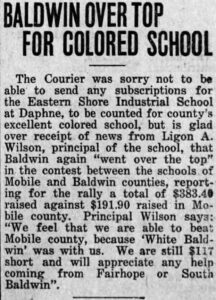
After Reverend S.B. Bracy stepped away from directly running the school to focus on leading the ESMBA, one of the men hired to oversee its operations was Ligon A. Wilson. Serving as principal from 1917 to 1927, Wilson brought a clear vision and dedication to the school, guiding it through a transformative decade of growth and development. Under his leadership, the School continued to expand its facilities and educational offerings, solidifying its reputation as a cornerstone of African American education in Baldwin County. Bracy’s decision to step back from running the school was driven by his belief that his true calling lay in his leadership role with the ESMBA. He recognized that he could make a broader impact by focusing on the association and creating a network of feeder schools that would provide foundational education for African American children throughout Baldwin County and the Eastern Shore. Confident that Baldwin County Training School was in capable hands under Wilson’s guidance, Bracy devoted himself to expanding educational opportunities across the region, laying the groundwork for a sustainable and transformative educational system. His vision and efforts ensured that African American students had access to learning and a pathway to greater opportunities.[6]
Footnotes
- http://Jun 27, 1919, Page 2.” – Fairhope Courier at Newspapers. Com Historical Newspapers from 1700s-2000s – Newspapers. Com. June 27, 1919. pg.2 par-1
- http://Danly Nancy “The History of Baldwin County Training School” 2009 pg.1 par-1
- http://Jun 27, 1919, Page 2.” – Fairhope Courier at Newspapers. Com Historical Newspapers from 1700s-2000s – Newspapers. Com. June 27, 1919. pg.2 par-2
- http://Danly Nancy “The History of Baldwin County Training School” 2009 pg.1 par-2
- http://Danly Nancy “The History of Baldwin County Training School” 2009 pg.6 par-1
- http://Danly Nancy “The History of Baldwin County Training School” 2009 pg.7 par-3